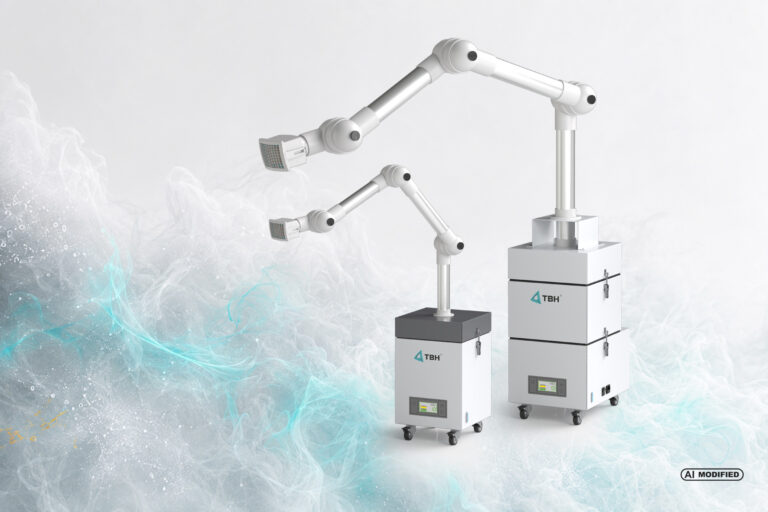

An industrial laser fume extraction system affects more than just the air in the workplace. This is because marking, engraving, cutting, or welding—depending on the material—generates fumes, fine particles, and gaseous components. If these emissions remain in the processing area, they can accumulate there and damage sensitive components.
Optics are particularly sensitive. Deposits on a lens can impair the conditions for stable machining and result in additional cleaning or maintenance efforts. That is why it is worth considering extraction as early as the planning stage of a laser system—and not only once the first deposits become visible.
Industrial laser fume extraction begins with capture
High-performance filtration technology is only effective if the emissions actually reach the filter and extraction system. That is why the position of the capture point and the airflow within the processing chamber play a crucial role.
Material, process parameters, enclosure, duct routing, and operating duration all influence how laser fumes spread and what extraction capacity is required. Especially with automated systems, the extraction technology must also interact reliably with the production process.
You can find more information on the various influencing factors and suitable systems in our Laser Fumes Solutions section.
Fewer Deposits in the Machine Enclosure
Fine particles can settle not only on the lens but also on other surfaces and components inside the machine. Capturing fumes as directly as possible reduces their entry into the area surrounding the processing site. As a result, the extraction system can help minimize cleaning efforts and protect sensitive machine areas from unnecessary deposits.
TBH offers modular filter and extraction systems for this purpose, whose configuration can be adapted to different laser processes. The LN200 series, for example, is suitable for applications with higher flow resistance, longer extraction paths, or smaller pipe diameters. Depending on the configuration, various pre-filters, particle filters, and activated carbon filters can be combined.
Integrating Process Quality and Occupational Safety
Emissions that spread throughout the machine room can also enter the work environment if they are not adequately captured. Therefore, the design should take into account not only the machine but also the potential exposure of employees.
For relevant applications, TBH offers configurations tested in accordance with EN ISO 21904. The appropriate system design always depends on the specific process, the substances generated and the intended operating conditions. Extraction and filtration should therefore be selected as part of the overall process concept rather than on the basis of a single filter specification.
A suitable industrial laser fume extraction system is therefore not achieved simply by selecting a single filter. Capture, airflow path, filter configuration, and system performance must all be properly matched.
Consider Laser Extraction Systems Already During System Planning
Those who only consider the extraction system after commissioning may have to retroactively adjust capture positions, duct routes, or system performance. If, on the other hand, it is planned together with the laser process, enclosure, and automation, the individual components can be coordinated with one another from the very beginning.
This is exactly what we’d like to discuss at the 35th BI-MU. The international trade fair for machine tools, robotics, automation, and digital and additive manufacturing will take place from October 13–16, 2026, at fieramilano Rho.
Are you planning a laser system or looking to optimize the extraction for an existing process? Talk to us at BI-MU about your specific application and where suitable filtration and extraction technology should be integrated into your process.