
Which extraction and filtration system effectively captures the fumes generated by your welding process?
Many companies find this question difficult to answer. In our LinkedIn survey, selecting the right filtration technology emerged as the greatest challenge for our customers. This result is understandable because welding processes differ considerably. Materials, filler metals, coatings, process parameters and working conditions all influence the emissions that arise.
Therefore, choosing suitable welding fume filtration does not start with a product. It starts with a detailed look at the application.
The following seven questions will help you identify the technical and regulatory factors that matter.
New European Rules Increase the Focus on Welding Fumes
In June 2026, the Council of the European Union and the European Parliament reached a provisional agreement on the sixth revision of the Carcinogens, Mutagens and Reprotoxic Substances Directive.
The agreed text provides for certain welding fumes to be included in Annex I of the directive. More precisely, it covers work involving exposure to fumes from welding processes that contain substances or mixtures classified as category 1A or 1B carcinogens, mutagens or reproductive toxicants.
However, the agreement still requires formal adoption following legal and linguistic review. EU member states will subsequently need to implement the final directive in their national legislation. Therefore, companies should monitor both the European legislative process and the rules that apply in their country.
The development increases the importance of reliable emission assessment, effective source capture and documented exposure control. Nevertheless, it does not create one universal filter specification for every welding process.
Source: Council of the European Union, provisional agreement of 23 June 2026
1. Which Materials Do You Weld?
The base material provides the first important clue. However, it does not tell the whole story.
Stainless steels, nickel alloys and other high-alloy materials may release substances such as chromium(VI) or nickel compounds. Coatings, oils, primers and residues can introduce additional particles, gases or vapours. In addition, the filler metal often influences the composition of the welding fumes more strongly than the workpiece itself.
Therefore, record all relevant materials before selecting a system:
- Base material
- Filler metal and welding consumables
- Coatings, primers and surface treatments
- Oils, cleaning agents and residues
- Material safety data and hazardous substance classifications
A reliable assessment should always consider the complete process rather than one material in isolation.
2. Which Welding Process Do You Use?
MIG/MAG, TIG, manual metal arc welding, laser welding and automated welding generate different emission levels and particle distributions.
For example, a process with a high deposition rate usually requires a different extraction concept from occasional precision welding. At the same time, laser welding may generate very fine particles even when the visible plume appears relatively small.
The following details influence the required welding fume filtration:
- Welding method
- Current, voltage and power
- Welding duration and duty cycle
- Manual or automated operation
- Number of simultaneous workstations
- Amount and composition of the welding fumes
Consequently, two applications using the same material may still require completely different extraction systems.
3. Where Can You Capture the Welding Fumes?
Effective filtration begins with effective capture.
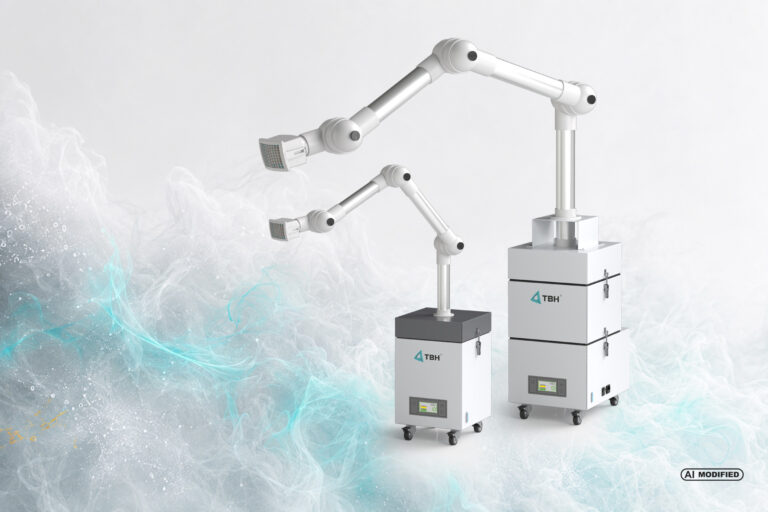
Whenever possible, capture the fumes close to their point of origin. This prevents them from spreading through the breathing zone or the production area. Depending on the process, suitable capture methods may include extraction arms, extraction nozzles, torches with integrated extraction, extraction tables or enclosed machine housings.
However, the capture point must not interfere with the welding process or shielding gas. Its position must also remain stable during operation.
Ask the following questions:
- How far is the capture point from the emission source?
- Does the welding torch move?
- Can the process area be partially or fully enclosed?
- Could cross-draughts disrupt the airflow?
- Can operators position the capture element correctly and consistently?
Even a powerful filtration unit cannot compensate for a poorly positioned capture element.
4. Should the Filtered Air Be Recirculated or Discharged Outside?
The answer depends on the pollutants, local regulations and site conditions.
Recirculated air can reduce heat loss and energy consumption. However, the complete system must reliably control the relevant pollutants, and national regulations may impose additional requirements. Furthermore, gaseous substances may require separate consideration because particle filters alone cannot remove them.
Discharging air outside can simplify some exposure-control decisions. Nevertheless, companies must consider replacement air, energy consumption, permits and environmental requirements.
Therefore, assess:
- Which particles, gases and vapours arise?
- Which occupational exposure limits apply?
- Do national rules permit air recirculation?
- Does the extraction system have suitable performance monitoring?
- How will the building replace the discharged air?
- Could the exhaust air create environmental or permitting obligations?
Do not decide between recirculation and exhaust air based on energy costs alone.
5. Which Filter Stages Does the Process Require?
A suitable system often combines several filter stages. Each stage performs a different task.
A prefilter or spark protection stage can capture coarse particles and protect the subsequent filters. A particle filter then separates fine and very fine particles. In addition, activated carbon or another gas filter may reduce certain gaseous compounds and odours.
However, activated carbon does not remove every gas. Its effectiveness depends on the substance, concentration, humidity, temperature and contact time. Therefore, companies should first identify the expected emissions.
A typical configuration may include:
- Spark or particle pre-separation
- Prefilter
- High-efficiency particle filter
- Optional activated carbon or process-specific gas filter
The right sequence protects the main filter and may extend its service life. It also makes welding fume filtration more predictable and economical.
For suitable system concepts, see the TBH TFS series, FP 200 series and Precotech 300.
6. What Airflow and Negative Pressure Does the Application Need?
A high airflow figure does not automatically guarantee effective capture.
The required airflow depends on the capture method, distance from the source, duct diameter, pressure losses and the number of connected workstations. Narrow hoses, long pipe runs, elbows and increasingly loaded filters can all reduce the effective airflow at the capture point.
Therefore, the decisive measurement is not only the nominal value stated for the extraction unit. What matters is the airflow available under real operating conditions.
The technical assessment should include:
- Required capture velocity
- Effective airflow at the capture point
- Necessary negative pressure
- Hose and duct dimensions
- Length and layout of the pipework
- Pressure loss across all components
- Filter loading during operation
This calculation helps prevent both insufficient capture and an unnecessarily oversized system.
7. How Will the System Remain Safe and Economical?
Selecting the system marks the beginning, not the end, of effective emission control.
Filters gradually load with particles. As a result, pressure loss increases and airflow may decrease. Companies should therefore monitor filter condition and replace filters before the extraction performance becomes insufficient.
In addition, employees need clear instructions for positioning capture elements, recognising warnings and handling used filters. Maintenance staff must also avoid unnecessary contact with collected hazardous substances.
Consider the following points:
- Filter saturation monitoring
- Airflow or negative-pressure monitoring
- Filter replacement intervals
- Safe and low-contamination filter changes
- Availability and cost of replacement filters
- Maintenance access
- System noise
- Energy consumption
- Documentation and employee instruction
A technically suitable system should protect employees and processes throughout its entire service life.
Regional Requirements: EU, Germany, United Kingdom and United States
Regulations differ between countries. Therefore, the legal section of the article should match the target market.
European Union
EU occupational safety directives provide the common framework, while member states implement them through national legislation.
The provisional 2026 agreement on the CMRD would bring certain welding processes involving category 1A or 1B CMR substances or mixtures explicitly within the directive’s scope. However, the final legal text and national implementation remain decisive.
Companies operating in several EU countries must therefore review the occupational exposure limits and implementation rules of each country separately.
Germany
In Germany, the Hazardous Substances Ordinance and the Technical Rules for Hazardous Substances apply. TRGS 528 specifically addresses welding work and describes protective measures, source capture and conditions for recirculating filtered air.
The German Institute for Occupational Safety and Health, IFA, also tests and certifies welding fume extraction equipment according to defined requirements. A W3 certification can document the performance of the complete tested unit in its certified configuration.
However, W3 does not replace the workplace risk assessment. The operator must still assess the materials, welding process, emissions, capture performance and operating conditions.
Source: German Social Accident Insurance, information on testing welding fume extraction equipment
United Kingdom
In Great Britain, employers must control exposure to welding fumes under the Control of Substances Hazardous to Health Regulations, or COSHH.
The Health and Safety Executive states that employers should use suitable engineering controls, typically local exhaust ventilation, for all indoor welding activities. This also applies to mild steel welding. General ventilation alone does not provide sufficient control. If local exhaust ventilation cannot adequately control exposure, employers must provide suitable respiratory protective equipment as an additional measure.
The UK does not use the German W3 system as a statutory approval requirement. Consequently, companies must assess equipment against COSHH, applicable workplace exposure limits and the actual control performance.
Sources: HSE safety alert on welding fumes and HSE guidance on welding health risks
United States
In the United States, OSHA regulates welding through general ventilation and safety requirements as well as substance-specific standards. For example, separate limits and control obligations apply to hexavalent chromium.
Therefore, US companies must identify the hazardous substances generated by the specific process and compare exposure with the applicable OSHA permissible exposure limits. State Plan states may set additional or stricter requirements.
The German W3 certification can provide useful technical evidence about a tested device. However, it does not automatically demonstrate compliance with OSHA requirements or local building, fire and environmental rules.
Sources: OSHA welding, cutting and brazing requirements, OSHA hexavalent chromium standards and NIOSH information on welding fumes
What Do W3, H14 and Activated Carbon Actually Mean?
These terms describe different aspects of an extraction system. Therefore, they should not be used interchangeably.
- W3 refers to a separation class and certification for welding fume extraction equipment. It assesses the complete device in its tested configuration.
- H14 describes the classification of a high-efficiency particle filter. It does not assess the complete extraction system or the capture efficiency at the workplace.
- Activated carbon can reduce certain gases and odours. However, its suitability and service life depend on the specific substances and operating conditions.
A system with an H14 filter does not automatically meet every requirement for welding fume extraction. Likewise, a W3-certified configuration does not remove every possible gaseous pollutant.
Therefore, companies should assess the entire chain: emission source, capture element, airflow, filter stages, monitoring and safe maintenance.
What Information Does TBH Need for an Application Assessment?
The more precisely you describe the process, the more accurately our specialists can assess suitable extraction and filtration concepts.
Please provide the following information where possible:
- Welding method
- Base materials and filler metals
- Coatings, oils and other residues
- Working time and duty cycle
- Number of workstations
- Manual or automated process
- Available capture options
- Existing hoses or pipework
- Required recirculation or exhaust-air operation
- Country in which the system will operate
- Photos or a layout of the workplace
- Available safety data sheets
If some information is not yet available, that is not a problem. The application assessment can also help identify which data still needs to be collected.
Which Welding Fume Filtration Solution Fits Your Application?
The right welding fume filtration depends on more than the filter class. Materials, processes, capture geometry, airflow, gaseous substances and national regulations all influence the final system design.
Therefore, start with the application rather than a catalogue specification.
Our extraction specialists will review your process information and discuss which capture and filtration concepts may be suitable. They will also identify any additional information needed for a technical assessment.