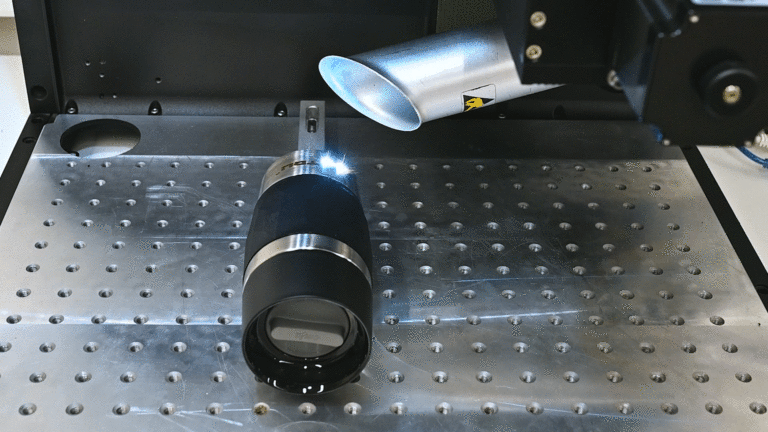
In medical laser applications, the thermal effects on tissue can generate airborne particles, aerosols, and gaseous components. This raises a key question regarding laser smoke extraction in medicine: How can these emissions be captured as directly as possible at the point where they are generated?
This is precisely where filter and extraction technology comes into play. It is not only the filtration performance that matters, but also the position of the capture element. The closer the capture point is to the source, the more effectively the contaminated air is directed into the filter and extraction system.
What does a laser smoke extraction system capture?
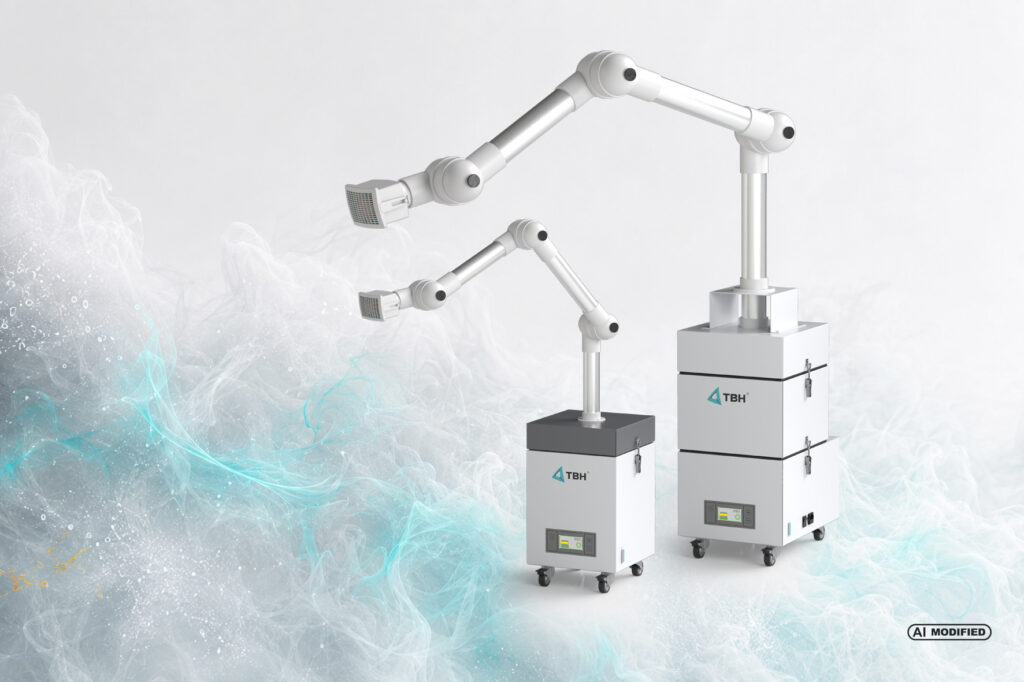
TBH filter and extraction systems capture the contaminated air during the laser procedure. This includes airborne particles, aerosols, and—depending on the application—gaseous components as well. The capture element is located close to the source. At the same time, when used as intended, it has no contact with the patient. Regulatory classification is also important: TBH does not market these systems as medical devices in this context. Instead, they serve as accessories for capturing and filtering the air generated during laser procedures.
You can find more information about TBH’s solutions for medical and aesthetic laser applications on our Medical & Aesthetic Systems page.
Why Extraction Is Important in Medical Laser Applications
Laser treatments can produce a mixture of biological, cellular, and gaseous components. Therefore, the filtration and extraction technology should capture the contaminated air as close as possible to the source. For medical laser smoke extraction, TBH offers the Health Pro and Health Pro Silence filtration and extraction systems for medical and aesthetic laser applications.
However, the right solution depends on the specific application. That’s why the following questions, among others, are important:
- Where is the laser smoke generated?
- How close can the extraction element be positioned?
- What particles and gaseous components are produced?
- How often and for how long does the laser application run?
- What are the requirements regarding noise levels and cleaning?
This allows the filtration and extraction system to be tailored to the specific process. After all, it is not a single filter class that determines the appropriate solution, but rather the interplay of capture, airflow, and filtration technology.
Talk to us about your laser application
Do you use medical or aesthetic lasers and want to know how you can capture the contaminated air generated during operation as directly as possible? Then come talk to us about your specific application at COMPAMED 2026 from November 16–19 in Düsseldorf, Germany.
You’ll find TBH at:
Hall 8B | Baden-Württemberg Joint Booth
For more information about the event, visit the official website of COMPAMED.
We look forward to a professional exchange regarding your laser application.