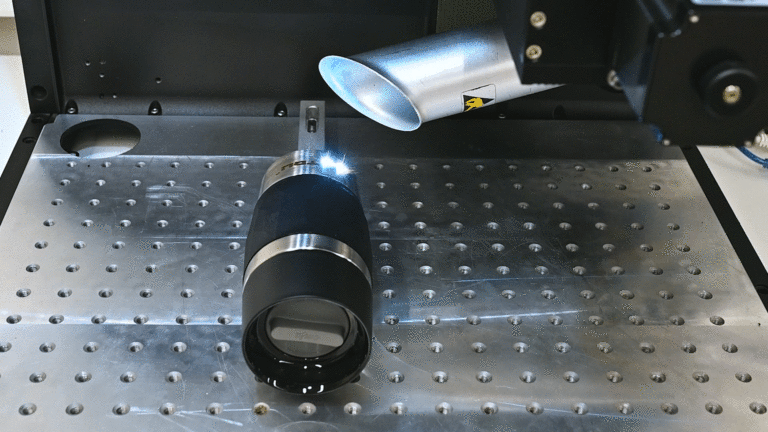
Laser cleaning leaves surfaces clean. Afterward, the surface is dry, precisely machined, and free of abrasive residues. This is precisely why many companies underestimate the second part of the process: emissions.
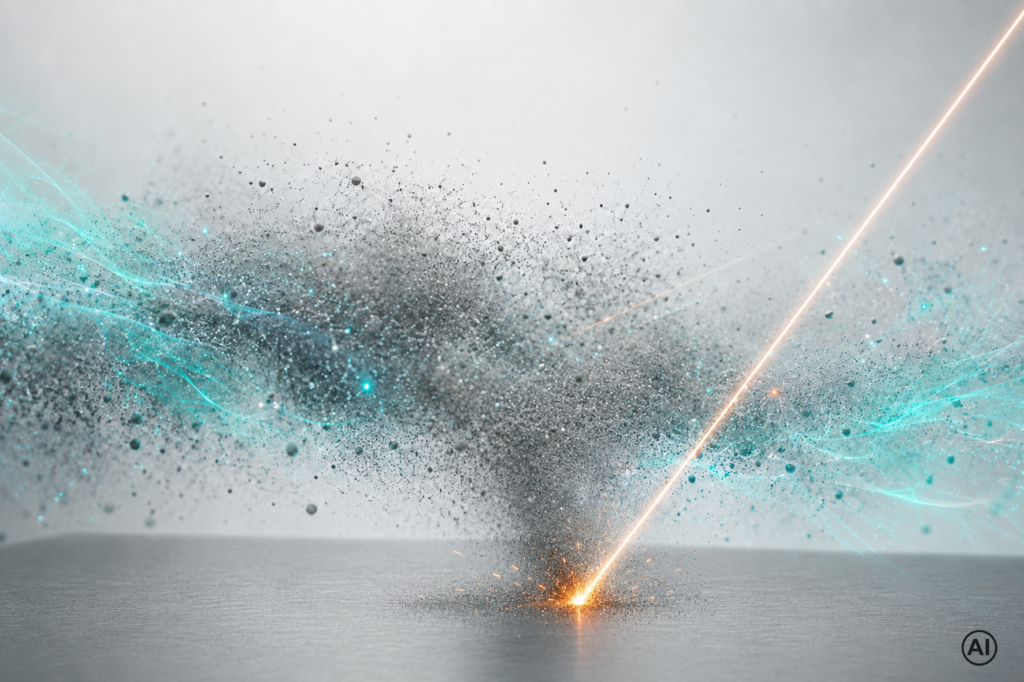
That’s because during laser cleaning, the removed layer doesn’t simply vanish into thin air. Depending on the material, coating, and process parameters, smoke, vapors, gases, and fine and ultrafine particles are generated. The BGHM explicitly points out that cleaning and stripping with laser radiation can produce mixtures of hazardous substances, the composition of which depends on the substances being removed and the laser used. Especially with coatings, the composition is often not fully known. BGHM, 2024
This makes it clear: Laser cleaning is often a precise and modern process. However, it is not emission-free.
Laser Cleaning Emissions: Why the Risk Is Often Underestimated
In practice, the focus is often on the laser class, the safety zone, and safety goggles. This is correct. However, it is not sufficient.
The DGUV identifies two key hazard areas for hand-held Class 4 laser devices used for cleaning and stripping: laser radiation and the hazardous substances generated during the processing. It also requires a functional, efficient extraction system; ablation byproducts should be captured as close as possible to the point of generation. DGUV FBHM-139, 2024
This is particularly important because the critical components are not always visible. Coarse smoke is noticeable, whereas ultrafine particles and gaseous components are not. Nevertheless, it is precisely these that can be relevant for inhalation exposure.
What Studies on Particles and Gases Show
The body of scientific evidence is growing. A study published in Environmental Research in 2024 examined airborne nanoparticles generated during laser cleaning of corroded 304L stainless steel surfaces. The study shows that laser cleaning can release nanoparticles and should therefore be included in a thorough exposure assessment. Park & Park, 2024
The French National Research and Safety Institute (INRS) also warns against the use of hand-held lasers for paint stripping, welding, and cutting. In laboratory tests on manual laser paint stripping of powder-coated steel, a high proportion of the fumes consisted of fine and ultrafine particles. In addition, INRS lists polycyclic aromatic hydrocarbons, isocyanates, ozone, benzene, and carbon monoxide, among others, as possible components of the emissions. INRS, 2026
Therefore, laser cleaning should not be categorically classified as “smoke-free” or “harmless to the air we breathe,” but rather evaluated on a process-by-process basis.
Laser cleaning emissions depend on the material
There is no single type of laser smoke. Corroded steel produces different emissions than stainless steel, painted components, plastics, oily residues, or multi-layer old coatings.
Therefore, companies must take a closer look: What material is involved? Which coating is being removed? Are pigments, fillers, additives, old paint layers, or unknown residues involved? And how close is the operator working to the process zone?
TRGS 528 specifies for thermal processes that material-specific, process-specific, as well as workplace- and task-specific factors must be included in the risk assessment. Among other things, it lists respirable dust, particles, and gases, as well as substance groups such as chromium(VI) compounds, nickel oxides, isocyanates, aldehydes, carbon monoxide, nitroso gases, and ozone. TRGS 528, 2020
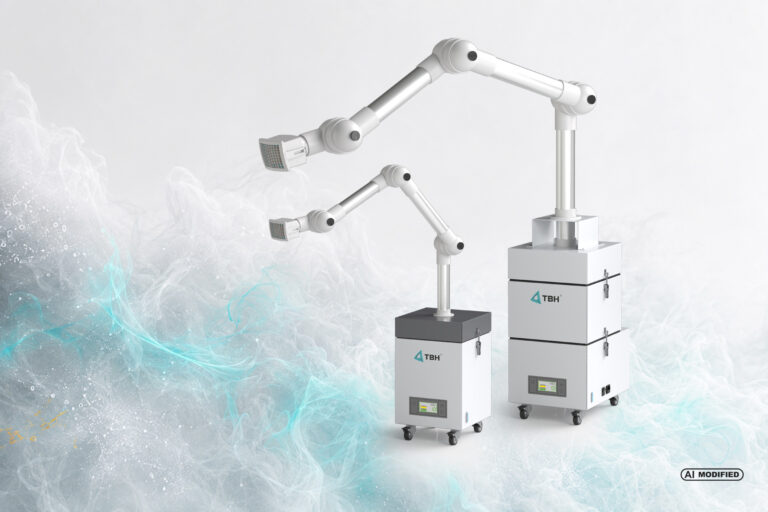
For extraction systems, this means: The system must be tailored to the actual process, not just to the laser power.
Source Capture Is More Effective Than General Ventilation
When it comes to laser cleaning emissions, capture is key. The closer the extraction system is to the source, the less the hazardous substance spreads throughout the work area.
TRGS 528 clearly states this principle: Hazardous substances should primarily be extracted at the source; the closer to the source, the more efficient the capture. TRGS 528, 2020
General room ventilation can be helpful. However, it is no substitute for effective source capture. The INRS notes that, for manual laser cleaning, general ventilation alone does not sufficiently control the chemical risk; fine particles, in particular, can quickly reach critical levels. INRS, 2026
Therefore, especially for hand-held applications, the combination of capture elements, airflow rate, airflow direction, filter technology, and work position is crucial.
Filter Technology: It’s Not Just About Particles
Many discussions revolve around HEPA or H filters. While this is understandable, it does not tell the whole story. This is because laser cleaning can generate not only particles but also gaseous components and vapors.
Proper extraction systems therefore address several questions simultaneously: What particle sizes are present? Can hazardous gaseous substances be generated? Is the air recirculated or vented to the outside? How is filter condition monitored? And how does the facility demonstrate that the protective measures are effective?
TRGS 528 requires an effectiveness assessment of protective measures, for example through workplace measurements or other suitable assessment methods. It also distinguishes between dust and gas measurements. TRGS 528, 2020
In short: Filter technology is not just an accessory. It is part of the protection concept.
What Companies Should Specifically Check Now
Anyone who uses or plans to use laser cleaning should not start by asking, “Which extraction unit is compatible with the laser?” A better approach is: “What emissions are generated by our process, and how do we safely capture them?”
This primarily includes:
- Identifying materials and coatings
- Critically evaluating unknown existing coatings
- Incorporating material safety data sheets or analyses
- Plan extraction as close as possible to the source
- Consider particles and gases separately
- Verify and document the effectiveness of protective measures
- Train employees on laser radiation and hazardous substances
The DGUV FBHM-139 provides practical guidance for assessing the risks of hand-held Class 4 lasers during cleaning and stripping. DGUV FBHM-139, 2024
Conclusion: Those who master laser cleaning also master the emissions
Laser cleaning can make processes cleaner, more precise, and more efficient. That is precisely why it is worth taking a professional look at the emissions. After all, safety does not come from assuming that a small amount of visible smoke means a low risk.
It comes from assessment, source identification, appropriate filtration technology, and verifiable effectiveness.
That is the difference between “laser cleaning works” and “laser cleaning is mastered.”
Sources
- DGUV: FBHM-139 Laser Work, Cleaning, and Stripping with Laser Radiation, 2024
- BGHM: Cleaning and Stripping with Laser Radiation—But Safely, 2024
- BAuA/AGS: TRGS 528 Welding Operations, 2020
- INRS: Warning Regarding Hand-Held Lasers, 2026
- Park, H. & Park, C.: Airborne Nanoparticles During Laser Cleaning, Environmental Research, 2024