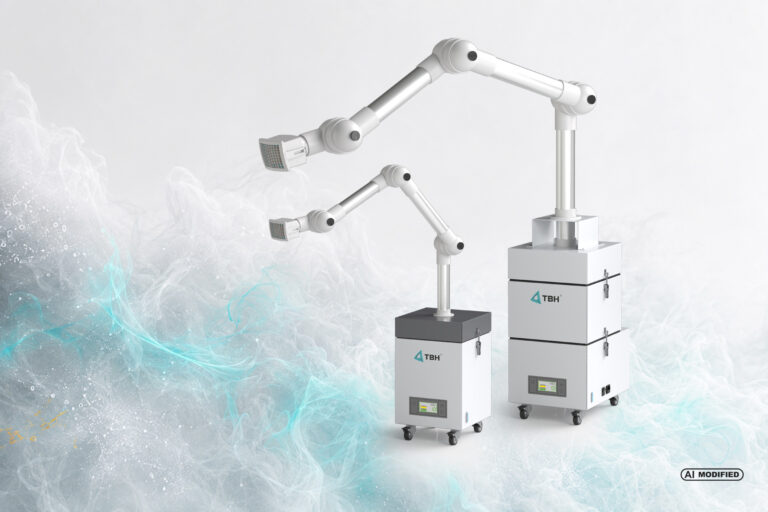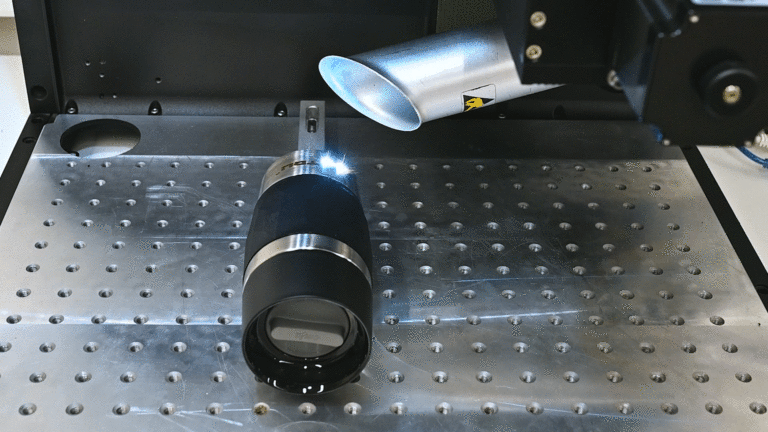

An energy-efficient extraction system is not necessarily the one with the highest airflow or the lowest power consumption. What matters is where pollutants are captured, how much air is actually needed for that purpose, and what happens to the purified process air afterward. In the case of laser fumes, welding fumes, soldering fumes, fine dust, or aerosols, pollutants are usually generated directly at the process site. If these particles are extracted close to the source, significantly less room air needs to be moved. This supports occupational safety and can simultaneously reduce energy consumption.
This is because any volume of air that is unnecessarily extracted must be mechanically moved, filtered, and, depending on the airflow path, replaced. This is particularly relevant in heated or air-conditioned production areas: If purified air—which has previously been heated or cooled—is vented to the outside, it draws additional energy from the room. This air must be replaced with fresh air and then reheated or recooled.
Therefore, the rule is: Extract as little air as possible, but as precisely as necessary—ideally right where particles, smoke, or vapors are generated.
Energy-Efficient Exhaust System: More Air Isn’t Necessarily Better
In practice, energy efficiency in exhaust systems is often associated with motor power or energy efficiency ratings. This view is too narrow. A high airflow rate can be useful if the process requires it. However, it can also consume unnecessary energy if contaminants aren’t captured in a targeted manner. If contaminated air is extracted only after it has spread throughout the room, significantly higher air volumes are required. At the same time, the risk increases that employees will come into contact with hazardous substances before they are captured. A well-designed extraction solution therefore does not move “as much air as possible,” but rather provides the appropriate airflow for the specific process.
What matters here is the effective airflow. Filters, hoses, extraction arms, and ductwork create resistance. Therefore, it is not just a theoretical maximum value that counts, but the airflow that is actually available at the workstation. The free-flow airflow is measured without resistance, while the effective airflow is determined only after factoring in filters, hoses, extraction arms, and other components.
EC Motors and Demand-Based Performance
Efficient motor technology is another key component. Brushless EC motors enable electronic speed control and can thus be adapted to actual demand. This is particularly relevant because not every process requires maximum extraction capacity at all times. However, an efficient motor alone does not make for an energy-efficient extraction system. It is the interplay of proper air intake, a suitable filter concept, a correctly designed airflow rate, and sensible airflow guidance that determines the energy balance.
With EC motors—that is, electronically commutated, brushless motors—the speed can be adjusted via electronic control, enabling performance to be tailored to actual needs.
Energy-Efficient Exhaust System and Air Recirculation
If purified process air can be recirculated back into the workspace, this can offer energy benefits. The already temperature-controlled room air remains inside the building instead of being vented outside as exhaust air. As a result, less outside air needs to be brought in, heated, or cooled. Process air is typically recirculated back into the workspace or, in the case of particularly critical processes or materials, vented outside. The advantage of recirculated process air is that the conditioned air remains in the room, thereby saving on heating costs.
Nevertheless, air recirculation is not always the right solution. In the case of hazardous substances, unclear risk assessments, or insufficiently verified separation efficiency, exhausting the air may be necessary. In such cases, the protection of employees takes precedence over energy savings.
Occupational safety takes precedence over energy efficiency
An energy-efficient exhaust system must never mean that airflow capacity is reduced in the wrong place. When dealing with hazardous substances, welding fumes, laser fumes, soldering fumes, or health-hazardous dusts, safe capture and filtration are the top priorities. Therefore, the best solution is not necessarily the one with the lowest power consumption at any cost. A filtration and extraction system is efficient when it reliably captures pollutants, avoids unnecessary airflow, and designs the airflow to suit the process.
Especially with hazardous substances, capture at the source is a key technical protective measure. Many technical regulations and standards prioritize technical protective measures in the following order: prevention, process-based extraction, ventilation measures, and personal protective equipment.
Conclusion: An energy-efficient extraction system starts with planning
Saving energy with extraction systems begins with proper planning. Capturing pollutants close to the source, an air flow rate tailored to demand, efficient EC motors, and a professionally evaluated decision between recirculation and exhaust ventilation can improve the energy balance. At the same time, one thing remains clear: If exhaust ventilation is required for occupational safety reasons, the protection of employees takes priority. An energy-efficient extraction system does not simply move as much air as possible; rather, it captures pollutants in a targeted manner—safely, according to demand, and as close as possible to the source.
Would you like to determine which filter and extraction system is right for your process?
Our team will assist you in selecting a suitable solution for your application, airflow rate, filter configuration, and airflow path.