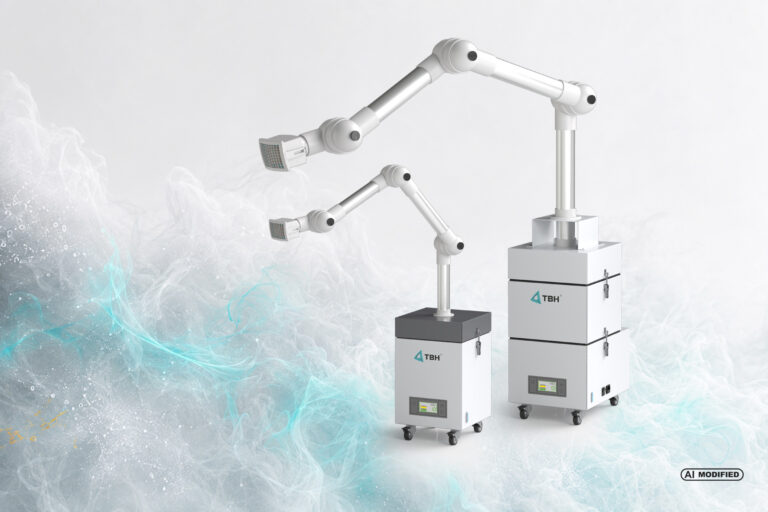

When choosing a laser fume extraction system, people often ask about the right filter first. This is understandable, since filter configuration, separation efficiency, and service life all affect occupational safety, maintenance, and operating costs. Nevertheless, a filter for laser fume extraction cannot be determined simply by a single filter class. The key factors are which substances are generated during the process, how effectively they are captured, and which filter combination is best suited to the specific application.
What function must the filter fulfill?
A filtration and extraction system passes contaminated process air through several filter elements that are tailored to the specific application. Depending on the process, pre-filters, particulate filters, and—in the case of gaseous components or odors—activated carbon filters are used. Prefilters reduce the load on downstream filter stages; particle filters remove fine particles; and activated carbon may be relevant for certain gaseous substances. The appropriate combination depends on the material, the emission volume, the particle size, and the airflow.
This is precisely why the filter should not be considered in isolation. If extraction at the source is ineffective, only a portion of the pollutants will reach the filtration system. The filter may be technically suitable, yet its effectiveness in the workplace remains limited. The basis for this is described in the article “Properly Detecting Laser Fumes,” which explains why extraction should be addressed before selecting a filter.
Why Filter Service Life Is Not a Fixed Product Specification
Many operators want to know how long a filter will last before making a purchase. However, a reliable answer is only possible if the process is known. Material, laser power, pulsing, processing duration, particle load, extraction design, airflow, and filter combination all influence service life. Even effective extraction can result in more particles reaching the filter. This is not automatically a disadvantage; rather, it may indicate that fewer emissions are entering the work area uncontrolled.
When making a purchase, therefore, the decisive factor is not how long a filter for laser fume extraction generally lasts. What is more important is determining what filter service life is realistic for your specific process and how maintenance, replacement filters, disposal, and system availability can be sensibly planned. Especially in cases of higher particle loads, sticky residues, or gaseous components, the filter system should be designed specifically for the application.
What Matters When Purchasing
A suitable filter solution takes into account particles and potential gaseous components, as well as maintenance and integration. Operators should clarify whether air recirculation is planned, what substances are generated during the process, whether there are specific occupational safety or environmental requirements, and how frequently filter changes are realistically feasible in day-to-day production. Standards, dust classes, or certifications should only be used as selection criteria if they are appropriate for the specific process and the chosen system.
The best filter system results from a combination of process understanding, capture efficiency, and airflow management. To learn which particles can be generated during laser processes and why size, number, and material are key factors in the design, read the article “Particle Size in Laser Fumes: Why the Process Matters.” If you’d like to evaluate a filter for laser fume extraction for your application, the TBH team can assist you in selecting the appropriate filter configuration, maintenance plan, and airflow design.
Have your filter configuration for your laser process evaluated