Extraction Systems for Laser Cleaning: Why They Are Important
Extraction systems for laser cleaning are a critical component of industrial laser processes. Laser cleaning selectively removes rust, paint residues, or metal oxides from metal surfaces—for example, as a pretreatment in toolmaking, manufacturing, or surface preparation.
The process is highly precise. At the same time, however, it generates smoke, fine particles, and, depending on the application, sparks. For this reason, extraction should not be considered as an afterthought but should be part of the process planning from the very beginning.
Video on the application:
You are currently viewing a placeholder content from YouTube. To access the actual content, click the button below. Please note that doing so will share data with third-party providers.
What happens during laser cleaning?
In laser cleaning, concentrated energy strikes the surface. The laser dissolves, vaporizes, or removes unwanted layers such as rust, oxides, deposits, or paint residues.
The emissions produced are primarily determined by the material, coating, process parameters, and laser source. Therefore, each application must be considered individually. Stainless steel, tool steel, aluminum, painted components, or oxidized surfaces can generate different particle and gas loads.
TBH describes laser processes in material processing as applications in which ultrafine particles in the µm and nm range can be generated. This is precisely why efficient extraction and filtration systems are important for occupational safety.
Extraction for laser cleaning begins with process planning
Extraction for laser cleaning should be considered right from the start when planning the laser process. This is because as soon as the laser removes residues from the metal surface, emissions are generated directly in the processing area.
Depending on the process, these include smoke, fine particles, ultrafine particles, and in some cases sparks. Furthermore, these emissions can spread throughout the work area or settle on machines, components, and surfaces if they are not captured early on.
That is why it is not just the filter and extraction system itself that matters. The capture element, the air flow rate, the filter configuration, the airflow path, and any accessories must also be suited to the application.
Extraction in laser cleaning: Why capture at the source matters
The most important factor in the extraction of laser emissions is proximity to the source. The sooner the extraction system captures smoke and particles, the lower the likelihood that they will spread throughout the work area.
The DGUV also points out in its guidance document on cleaning and stripping with laser radiation that hazards from hazardous substances generated during these activities may arise. The guidance document specifies a functional, efficient extraction system and recommends capturing ablation products as close as possible to the source.
This applies particularly to open or partially open applications. An extraction hood, a suitable capture element, or an application-specific enclosure can capture the emissions where they are generated.
What role do smoke, fine particles, and sparks play?
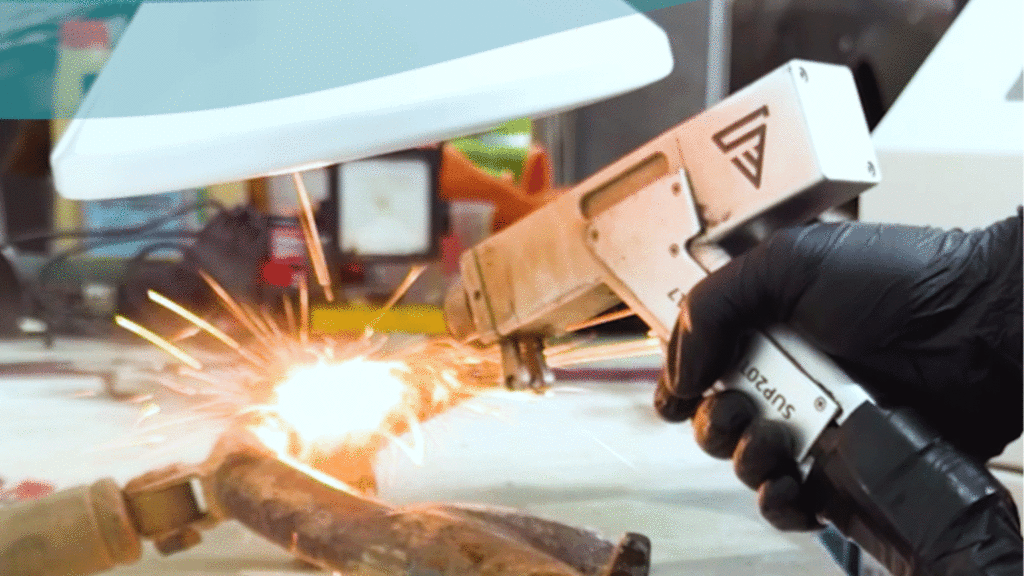
The video clearly shows that visible smoke is produced when removing residues from metal surfaces. At the same time, fine and ultrafine particles can be generated that are not reliably detectable to the naked eye.
When it comes to dust and particle emissions, therefore, it is not just the visible cloud of smoke that matters. Particle size, composition, concentration, and duration of exposure are also critical.
The BGHM recommends that for activities involving hazardous substances, information about the hazardous substances generated should be obtained, limit values should be taken into account, and, if extraction is necessary, the hazardous substance should be captured as directly as possible at the point of generation.
When a spark arrester may be useful
Additionally, sparks can be generated during laser cleaning. This depends, among other things, on the surface, energy input, and process control.
For the application shown, we therefore recommend a spark arrester as well. TBH offers suitable spark arresters as accessories for the TFS series. However, the appropriate model depends on the specific air flow rate and the particular application.
Therefore, the spark arrester should always be considered in conjunction with the filter and extraction system.
Why a standard vacuum cleaner is not a suitable solution
A simple vacuum cleaner is not sufficient for professional laser processes. Laser cleaning does not produce ordinary contamination such as chips on the floor. Instead, airborne emissions are generated directly during the process.
These emissions must be specifically captured, routed, and filtered. This is why a coordinated extraction concept is required.
This includes, among other things:
- appropriate capture directly at the source
- suitable airflow
- appropriate filter equipment for particles and, if necessary, gaseous components
- safe routing of process air
- assessment of sparks, hot particles, and fire risks
- maintenance and filter replacement concept
This is precisely why the extraction system for laser cleaning should always be designed to suit the material, the surface, and the process.
TBH Filter and Extraction Systems for Laser Processes
TBH develops and manufactures modular filter and extraction systems for industrial applications. For laser processes, TBH designs systems and accessories based on the specific process.
Several factors come into play here: material, emission volume, capture conditions, air flow rate, filter equipment, and potential spark generation. Therefore, it is not sufficient to consider just a single component.
You can find more information on laser fume extraction here:
Laser fumes – TBH GmbH Filter- und Absauganlagen
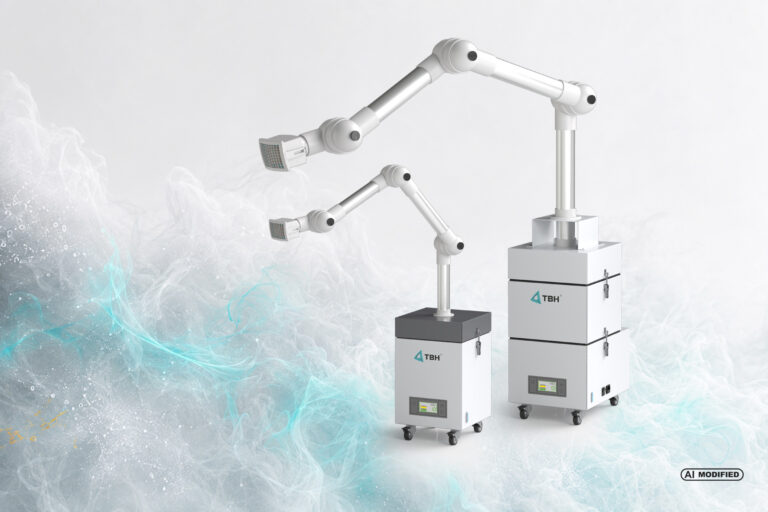
Example: TFS 250 with suitable capture
For applications such as laser cleaning on metal surfaces, a TFS filtration and extraction system with a suitable extraction hood can be a practical solution.
The key factor here is the interaction between capture, airflow, filter technology, and accessories. The system must not only move air but also capture the resulting emissions as directly as possible at the source and filter them reliably.
You can find more information about the TFS 250 here:
https://www.tbh.eu/produkt/tfs-250/
In this application, we also recommend the use of a spark arrester. We will work with you to determine which model is best suited based on the specific process.
Conclusion: Laser cleaning and extraction go hand in hand
Laser cleaning can offer many advantages in manufacturing, toolmaking, and surface pretreatment. At the same time, the process generates emissions that should not be allowed to enter the work area uncontrolled.
Anyone using laser cleaning professionally should therefore plan for extraction early on. A well-planned extraction system for laser cleaning helps capture smoke, fine particles, and process-related sparks directly at the source.
How do you handle extraction during laser cleaning?
Talk to us about your specific application. Together, we’ll determine which filtration and extraction solution is right for your process.
FAQs on Extraction for Laser Cleaning
What emissions are generated during laser cleaning?
Laser cleaning can produce smoke, fine particles, and, depending on the material or coating, gaseous components. Under certain process conditions, sparks may also occur.
Why is capturing emissions directly at the source important?
The closer the extraction system captures emissions at the source, the less smoke and particles can spread throughout the work area. This provides better protection for employees, machines, and the surrounding environment.
Is a spark arrester required for laser cleaning?
That depends on the specific process. If sparks or hot particles may be generated, the operator should consider using a spark arrester.
In the application shown here, we recommend a spark arrester.
Which extraction system is suitable for laser cleaning?
There is no one-size-fits-all answer. Key factors include the material, surface residues, laser parameters, emission volume, capture conditions, and desired airflow. TBH provides application-specific consulting.