
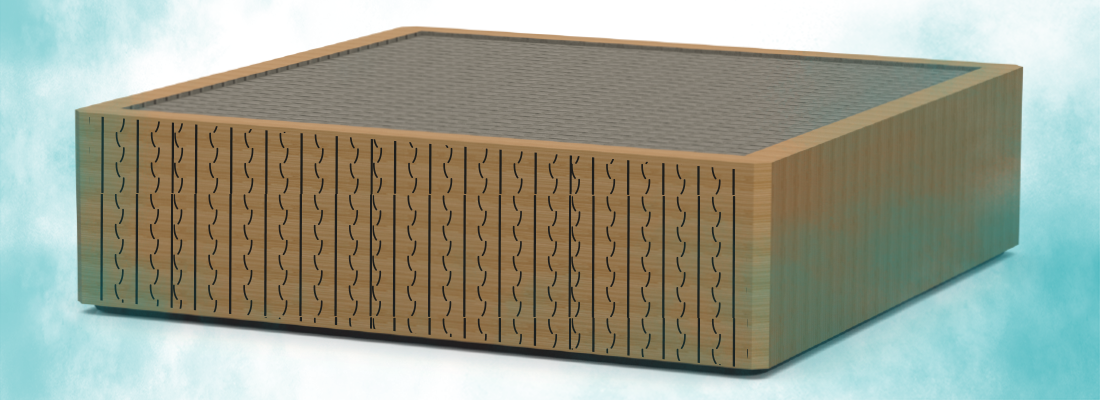
An overview of the most important dust filters and their areas of application.
Many production processes generate dust, particles, and aerosols that must be reliably filtered out of the air. However, not every dust filter is suitable for every application. Knowing the differences allows you to select the right filter solution and thus optimally protect employees, the environment, and machines.
This article provides an overview of the most common types of dust filters and explains what they are best suited for.
Aluminum filter (G3)
The aluminum filter consists of aluminum wire mesh and serves as a coarse dirt filter.
✅ Typical areas of application:
- Hair
- Lint
- Coarse dust
With the G3 filter standard, it offers robust basic separation and is often used as the first filter stage.
Pre-filter mat (F5)
The pre-filter mat is a fine dust filter with very low capacity. It is suitable for simple applications and is often used as a cost-effective alternative to bag filters.
Filter standard: F5
Application: Separation of small amounts of fine dust
Advantage: Inexpensive and easy to replace
Bag filter (F5–F6)
The bag filter is a saturation filter and can also serve as a pre-filter. Its large filter area makes it significantly more efficient than the pre-filter mat.
✅ Advantages:
- Long service life
- Suitable for high dust loads
- Flexible application options
With filter standards F5 to F6, the bag filter is a reliable choice for applications with increased dust exposure.
Z-line filter (F6–F7)
The Z-line filter owes its name to its jagged shape. This gives it a high capacity and means it saturates less quickly.
Filter standard: F6–F7
Application: Separation of fine dust
Advantage: Longer service life and lower maintenance requirements
Particle filters (HEPA/ULPA range)
Particle filters are used for particularly demanding applications. They can reliably separate extremely fine particles such as smoke, oil mist, or nanoparticles.
- Typical application: Laser processes, welding fumes, chemical emissions
- Highest filter performance (e.g., HEPA H13/H14 or ULPA)
- Guarantee virtually particle-free air
Conclusion: Selecting the right filter
The choice of the right dust filter always depends on the type and quantity of particles. While aluminum filters reliably separate coarse dirt, particle filters are indispensable for the finest emissions.
Tip: Often, a combination of several filter stages is the most efficient solution – starting with a coarse filter, through fine dust filters, to particle filters for the highest requirements. This not only ensures the health of your employees, but also the service life of your machines and contributes to environmental protection.
