
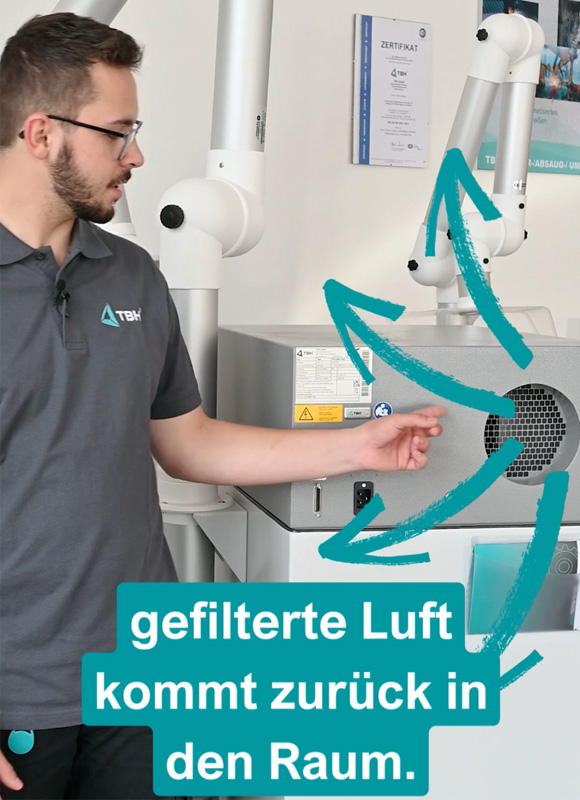
Whether laser cutting, welding, soldering, grinding, or decanting: many industrial processes generate particles, dust, aerosols, gases, and vapors. The key question is then: Should the purified air be returned to the room (recirculated air) or discharged to the outside or into a central ventilation system (exhaust air)?
This article provides a clear overview—technically understandable, practical, and with a checklist to help you make your decision. As always, the goal is to protect human beings, the environment, and machinery.
Recirculated air and exhaust air explained briefly
Recirculated air mode means: The extracted process air is filtered and then returned to the room.
Exhaust air mode means: The filtered process air is discharged to the outside or fed into a central ventilation system.
Both concepts have their merits – the decisive factors are the type of substance, concentration, process risk, standards/specifications, and the overall concept of your ventilation system.
When recirculation can be useful
Recirculation can offer advantages in practice if the following points are met:
- Energy efficiency: Heat remains in the building (relevant, for example, during the heating season).
- Simpler building integration: No additional exhaust air ducting to the outside required (depending on location/planning).
- Stable room air flow: In some production areas, a constant room air balance is important.
It is important to note that recirculated air is only a good solution if the filtration is suitable for the risk assessment and substance profile and if operation (including maintenance/monitoring) is implemented safely on a permanent basis.
When exhaust air is often the better choice
Exhaust air is often preferred when:
- Health-hazardous substances are produced or cannot be reliably excluded,
- Odors/gases/vapors remain relevant even after particle filtration (e.g., solvents),
- Process peaks occur (short-term high emission rates),
- or conservative, clearly defined air flow is required.
Hazardous substances: What you should consider in your decision
The following applies to hazardous substances: The risk assessment is the starting point – and thus also the question of whether recirculation is permissible and sensible at all.
A practical example: Particularly strict requirements apply to carcinogenic, mutagenic, or reprotoxic substances (CMR). In this context, it is specified, among other things, that extracted air containing CMR substances of certain categories must not enter the breathing air. Accordingly, depending on the process, exhaust air ducting may be the obvious measure – or a clearly proven separation efficiency and a suitable safety concept may be required.
Note: The more critical the substance, the more important it is to have verifiable filter performance, monitoring (e.g., volume flow/filter condition), and a clearly defined approach to maintenance and filter replacement.
Technical check: 6 questions you should ask yourself
1) Which substances are actually produced?
Particles (dust/smoke), aerosols, gases/vapors – often it is a mixture. In the case of vapors/gases, additional stages (e.g., activated carbon) are often relevant.
2) How high are the emissions – continuously and at peak times?
Continuous, cyclical, or with peaks? Peak loads influence dimensioning and operational safety.
3) What is your ventilation situation?
Is there central ventilation? What are the supply/exhaust air flows in the room? Recirculated air must not cause the entire system to “run out of sync.”
4) Which standards/specifications are relevant for your process?
Depending on the application, requirements for welding fume/laser fume extraction (W3, DIN EN ISO 21904) or dust classes may play a role, for example.
5) How do you ensure operational safety in everyday use?
Filter loading, maintenance intervals, condition monitoring, documented procedures – without a reliable routine, even the best technology becomes vulnerable.
6) How important are energy and operating costs in the overall picture?
Recirculated air can have energy advantages – exhaust air can offer safety reserves. The overall picture is decisive.
Practical examples: typical trends
- Welding/laser smoke: often high occupational safety requirements; depending on the process, W3-compliant solutions may be relevant.
- Adhesive, cleaning, decanting, or injection molding processes: vapors/gases may dominate here – exhaust air or multi-stage filtration (including gas phase) is often useful.
- Dry dust (grinding, deburring, milling): depending on the dust class and quantity, recirculated air may be possible – provided that the filter concept, separation efficiency, and monitoring are suitable.
Checklist to take with you
If you want to make a quick preliminary decision internally, this short checklist will help:
Recirculated air is more suitable if …
- the substance profile and limit values have been clearly evaluated,
- The filter performance is demonstrably suitable for the application,
- Monitoring/maintenance is reliably organized,
- And energy efficiency is a key objective.
Exhaust air is preferable if …
- Hazardous substances/CMR/critical emissions are involved,
- Vapors/gases play a role,
- Process peaks occur,
- Or maximum robustness in occupational safety is prioritized.
Conclusion
Recirculating air or exhaust air is not a matter of taste, but a decision based on substances, risk, standards, ventilation concept, and suitability for everyday use. If you evaluate these points in a structured manner, you will quickly find the right system—and create sustainably clean process air for humans, the environment, and machines.
Would you like to have your application evaluated (recirculating air/exhaust air, filter stages, monitoring, integration into your ventilation system)?
Talk to us: Contact – TBH GmbH Filter and Extraction Systems
More about TBH extraction and filter systems: https://www.tbh.eu
