Laser cleaning often appears to be a clean process. In occupational safety, however, appearance is not the deciding factor. The relevant question is what the process releases into the air. Published research shows that laser cleaning can generate airborne aerosols, including fine and submicron particles. That matters because exposure control has to address not only the laser beam itself, but also the contaminants created during material removal.
What the research shows
The core takeaway is straightforward: laser cleaning should not be treated as an emission-free process. Aerosol formation depends on the substrate, the layer being removed, and the process setup. As a result, the hazard profile can vary significantly from one application to another, even when the same laser technology is used.
For occupational safety practice, that is highly relevant. Fine and ultrafine particles are exactly the kind of emissions that should be captured as close as possible to the point of origin.
Why the topic should be viewed internationally
For an English-language audience, the topic should not be framed only through one national rule set. A more useful structure is to begin with internationally recognized machine-safety and process-safety standards, then add the regional legal frameworks that shape employer obligations in practice. That approach is more relevant for readers in Europe, North America, and third countries that work with ISO-based safety concepts or follow comparable risk-assessment logic.
Which international guidance matters
At international level, the ISO 11553 series is a key reference for laser processing machines. ISO 11553-1 addresses hazards generated by laser processing machines, including radiation hazards and hazards generated by materials and substances. ISO 11553-2 specifically addresses hand-held or hand-operated laser processing devices and focuses on hazard analysis, risk assessment, and protective measures.
For laser cleaning, that framing is important because the safety question is not limited to beam exposure. It also includes what the process generates in the air. This makes an international standards-based reading more useful than a narrow country-by-country view.
Why source capture matters
For laser cleaning, general room ventilation alone is not a robust control strategy. The more reliable approach is source capture combined with filtration matched to the actual emission profile.
In practice, that means the extraction concept should be designed around the real process rather than around the assumption that laser cleaning is “clean.” Relevant factors include the base material, any coating or residue being removed, the expected particle load, possible gaseous emissions, the capture position, airflow, duct routing, and whether cleaned air will be recirculated or discharged.
Which U.S. guidance matters
For U.S. readers, the relevant framework is typically a combination of OSHA exposure-control requirements, OSHA ventilation guidance, and laser-processing safety standards recognized by OSHA. OSHA points to ISO 11553-2 for hand-held laser processing devices, which makes it a useful bridge between international machine-safety logic and U.S. workplace practice.
That is important because hand-held systems used for cleaning and decoating need to be assessed not only for beam hazards, but for the full operating context. In other words, safe use depends on both radiation safety and control of the airborne contaminants generated during the process.
Which European guidance matters
For European readers, the topic is shaped by several layers. Directive 2006/25/EC covers worker exposure to artificial optical radiation. Directive 98/24/EC covers risks related to chemical agents at work. Where carcinogenic or mutagenic substances are relevant, Directive 2004/37/EC adds another layer of worker protection.
For laser cleaning, that means the European reading is also dual: employers have to consider both the optical-radiation hazard and the hazardous substances generated during processing. Safe operation is therefore not only about laser class and shielding. It also requires suitable engineering controls, including capture and filtration where airborne contaminants are generated.
A brief Germany note
For Germany, DGUV FBHM-139 is the more direct practical reference for hand-held Class 4 laser cleaning and decoating systems. TRGS 528 can still serve as a benchmark for source-capture logic in metal-emission contexts, but in an English-language article it should remain a short Germany-specific note rather than the main framing.
Why W3 still matters internationally
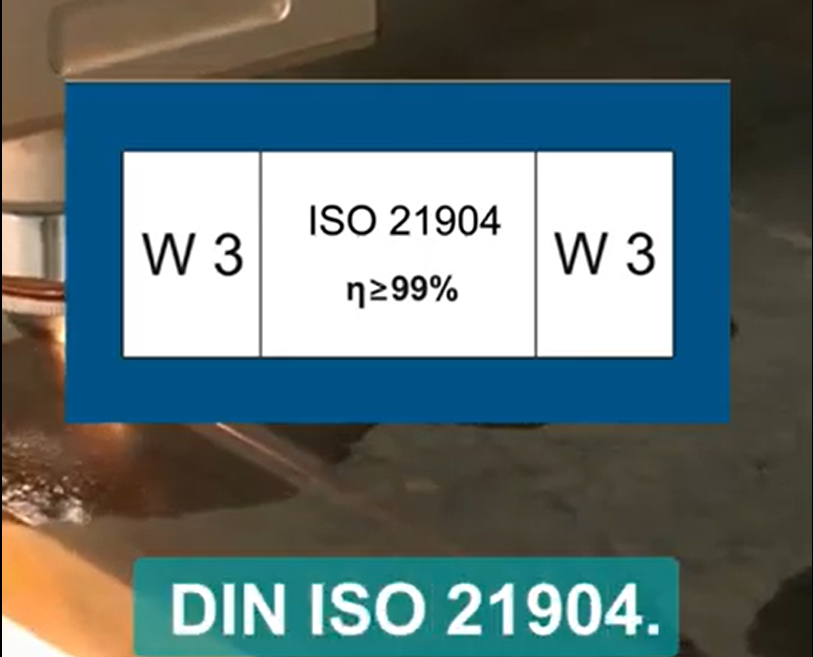
W3 is not the global legal baseline for laser cleaning, but it remains an important technical reference, especially for readers in Europe and in export markets that compare filtration concepts internationally. According to DGUV, the IFA tests and certifies welding fume extraction devices in accordance with DIN EN ISO 21904-1 and -2, and certified devices may be marked W3.
For laser cleaning, W3 should therefore be presented carefully: not as an automatic approval for every process, but as a relevant reference where metallic particulate emissions, recirculated air, or neighboring welding and thermal-processing applications are part of the environment. Its value lies mainly in the filtration and recirculation context, while final suitability still depends on the actual process and risk assessment.
Which extraction system is suitable?
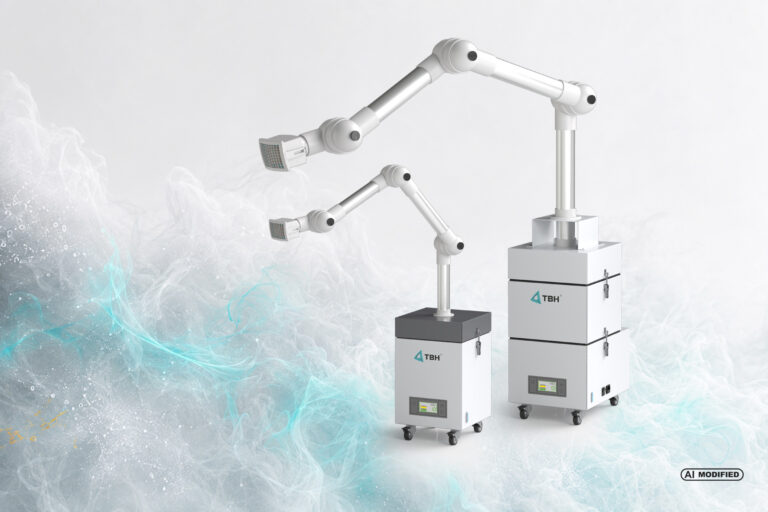
For laser-related smoke and fume applications, TBH positions the TFS series as an industrial extraction system certified according to DIN ISO 21904 (W3) for laser marking, laser engraving, and automated welding processes.
Which configuration is suitable always depends on the specific process. Decisive factors include the material, the surface condition, the emission profile, the required airflow, the duct length, the capture geometry at the source, and whether odors or gaseous components must also be considered. This is especially important in laser cleaning because emissions are influenced not only by the laser, but also by coatings, residues, and the removal mechanism itself.
Conclusion
The key occupational safety message is simple: laser cleaning is not automatically a low-emission process. A more internationally useful reading combines ISO-based machine safety, source-capture principles, U.S. ventilation guidance, European optical-radiation and chemical-agent requirements, and a process-specific risk assessment.
A defensible safety concept therefore starts with the actual process: what is being removed, which contaminants are created, how they are captured, how they are filtered, and whether the selected extraction system is appropriate for that application.
FAQ
Is laser cleaning an emission-free process?
No. Published research shows that laser cleaning can generate airborne aerosols, including fine and submicron particles.
Is general shop ventilation enough on its own?
No. Source capture is the more robust approach.
Which guidance is most relevant internationally?
For an international English-language audience, the most useful starting point is ISO 11553-1 and -2, then the applicable regional framework such as OSHA in the U.S. or the EU directives on artificial optical radiation and chemical agents.
What does W3 mean?
W3 identifies welding fume extraction devices that the IFA of the DGUV tests and certifies in accordance with DIN EN ISO 21904-1 and -2.
Does a published study replace a site-specific risk assessment?
No. A study is an important technical indication, but it does not replace a process-specific occupational risk assessment for the actual workplace, materials, and extraction concept.
Sources
OSHA, Laser Hazards – Standards. OSHA references ISO 11553-1 for laser processing machines and ISO 11553-2 for hand-held laser processing devices, including hazards generated by materials and substances. (Berufsgenossenschaft)
OSHA, Technical Manual – Local Exhaust Ventilation. OSHA describes local exhaust ventilation as capture at or near the source before contaminants disperse into workplace air. (Berufsgenossenschaft)
NIOSH, Control of Smoke From Laser/Electric Surgical Procedures. NIOSH states that general room ventilation alone is not sufficient to capture contaminants generated at the source and recommends local exhaust ventilation as part of the control concept. (CDC)
ISO, ISO 11553-2. The standard addresses hand-held or hand-operated laser processing devices and focuses on hazard analysis, risk assessment, and protective measures. (Berufsgenossenschaft)
ISO, ISO 21904-1. The standard defines general requirements for ventilation equipment used to capture and separate fumes generated by welding and allied processes. (ISO)
EUR-Lex, Directive 2006/25/EC. This directive sets minimum health and safety requirements regarding worker exposure to risks arising from artificial optical radiation. (EUR-Lex)
EUR-Lex, Directive 98/24/EC. This directive covers the protection of workers from risks related to chemical agents at work. (EUR-Lex)
EUR-Lex, Directive 2004/37/EC. This directive covers the protection of workers from risks related to exposure to carcinogens or mutagens at work. (EUR-Lex)
DGUV, FBHM-139: Blasting Work – Cleaning and Decoating with Laser Radiation. DGUV states that the guidance serves as a basis for risk assessment and relates exclusively to hand-held Class 4 laser equipment for cleaning and decoating; it also notes that the main hazards arise from laser radiation and hazardous substances emitted during processing, and that a functional, efficient extraction system is to be provided. (DGUV Publikationen)
DGUV / IFA, Welding Fume Separation Equipment – Testing and Certification. DGUV explains that the IFA tests and certifies welding fume extraction devices in accordance with DIN EN ISO 21904-1 and -2 and that certified devices may be marked W3. (ISO)
TBH, TFS series. TBH describes the TFS series as an industrial extraction system certified according to DIN ISO 21904 (W3) for laser marking, laser engraving, and automated welding processes. (TBH GmbH Filter- und Absauganlagen)
Research article, Investigation of aerosol generation through laser cleaning of various surfaces. The published study examines aerosol generation during laser cleaning of carbon steel, stainless steel, and concrete. (Berufsgenossenschaft)