
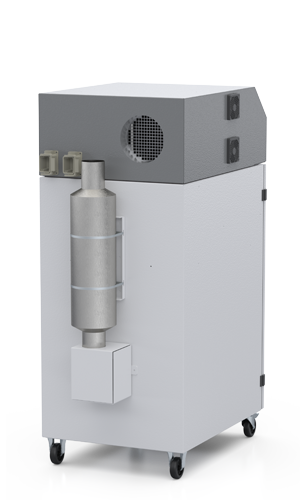
Preventing fires in filter systems: Using spark extinguishers correctly
Glowing particles are part of everyday life in metalworking—during welding, grinding, or thermal cutting. What many people underestimate is that these particles can be carried away by the air flow and end up in hose systems, pipelines, and filter systems. In the worst case, a single ember is enough to ignite deposits or filter media.
In this article, we show how fires typically start – and why a spark extinguisher can be a simple, effective preventive measure.
Why filter systems can catch fire in the first place
Fires in extraction systems rarely start “out of nowhere.” Usually, several factors come together:
- Ignition source: Sparks, glowing chips, hot particles from the process
- Transport route: Hose/pipe carries the particles further (often faster than expected)
- Combustible material: Dust deposits, filter cake, possibly oil/emulsion components or fine particle mixtures
- Oxygen & energy: The air flow provides both – and keeps the reaction going
The drier and finer the dust, the more critical the situation can become – especially with longer hose lengths, high flow velocities, or irregular maintenance.
Typical risk processes in metalworking
Critical particles occur particularly frequently in these applications:
- Welding (welding spatter, flying sparks depending on the process/material)
- Grinding/deburring (glowing particles at high energy)
- Plasma/flame cutting (hot particles and slag components)
- Dry machining (dust without “cooling” liquid)
If these particles travel unchecked toward the filter, the filter system may become a “final storage site” for ignition sources.
Spark extinguishers: Preventive fire protection in the air stream
A spark extinguisher is designed to cool or “defuse” sparks and glowing particles before they reach the filter. The principle: targeted air flow or deflection causes particles to lose temperature and energy, significantly reducing the risk of something igniting in the system.
Important: a spark extinguisher is no substitute for a risk assessment, but it is often a very effective, pragmatic component of a safety concept.
The key point: install as close to the source as possible
In practice, the position makes all the difference.
Recommendation: Install the spark extinguisher as close as possible to the point of capture.
Why? Because this prevents sparks from traveling long distances in the hose system in the first place – exactly where deposits can form and fires can “migrate.”
Mnemonic: The shorter the distance to the “defusing” point, the lower the fire risk in pipes and filters.
Selection & installation: What matters in practice
To ensure that a spark extinguisher really helps in everyday use, you should pay attention to the following points:
Design to suit the air volume flow (too small = high losses/poor effect, too large = unnecessary)
Choose the type of installation to suit the system or workplace (e.g., in the pipeline or as a module)
Ensure accessibility for visual inspection (even if it is often low-maintenance mechanically)
Check the overall concept: This includes hose lengths, bends, pre-separation, filter concept, and maintenance intervals
If you frequently work with flying sparks, it is worth considering this issue not as an “accessory” but as an integral part of system planning.
Additional measures that have proven effective
A spark extinguisher is powerful – but it is even better if you take a holistic view of the system:
1) Pre-separation for high particle volumes
If there is a lot of coarse dust or chips, pre-separation (e.g., according to the principle of gravity) can relieve the load on the filter and system – and at the same time reduce combustible material in the filter area.
2) Monitoring instead of surprises
For processes involving flying sparks, filter/system monitoring can be useful for detecting mechanical or thermal damage at an early stage and reacting in good time.
3) Maintenance
- Avoid deposits in pipes (cleaning intervals)
- Empty containers regularly
- Change filters according to schedule (and handle contaminated dust safely)
- Minimize ignition sources in the workplace (spark direction, shielding, process parameters)
Mini checklist for HSE & maintenance
Quick check in the workplace:
- Are there visible flying sparks or glowing particles in the process?
- How long is the distance to the system (hose/pipe)?
- Where do dust deposits accumulate (bends, reducers, horizontal sections)?
- Is pre-separation or spark extinguishing provided for?
- Are maintenance, emptying, and filter changes documented and adhered to?
If you hesitate on 2–3 points: This is usually the moment when it is worth taking a look at the safety concept.
Conclusion: Safety is not a coincidence – it’s a system
Fires in filter systems are not inevitable. If you understand the chain of events that leads to a fire, you can interrupt it: defuse ignition sources, shorten transport routes, reduce deposits, and monitor the system cleanly.
A spark extinguisher is one of the most effective measures for this – especially if it is located close to the emission source and fits into the overall concept.
You can find more practical knowledge about filter safety, extraction technology, and applications in the TBH blog: Blog – TBH GmbH Filter and Extraction Systems
Talk to us: Contact – TBH GmbH Filter and Extraction Systems
More about TBH extraction and filter systems: https://www.tbh.eu
