
ATEX for non-metallic dusts:
Where combustible, non-metallic dusts are produced, a normal work step can quickly become a risk: an ignitable dust atmosphere, an ignition source – and suddenly there is a risk of explosion. This is precisely why explosion protection is not a “nice-to-have,” but a central component of safe process design.
At TBH, we understand explosion protection for what it is: consistent protection of human beings, the environment, and machinery.
ATEX in practice: Assessing risks, implementing measures
As an operator, you are required to assess the risk and define the ATEX zones. In the case of dust, this typically refers to zones 20 to 22, depending on how often and for how long an explosive atmosphere can occur.
To turn this obligation into a clean process, you need:
- a clear assessment of the dust (material data, process conditions),
- a suitable technical solution,
- and documentation that describes the entire system in a comprehensible manner.
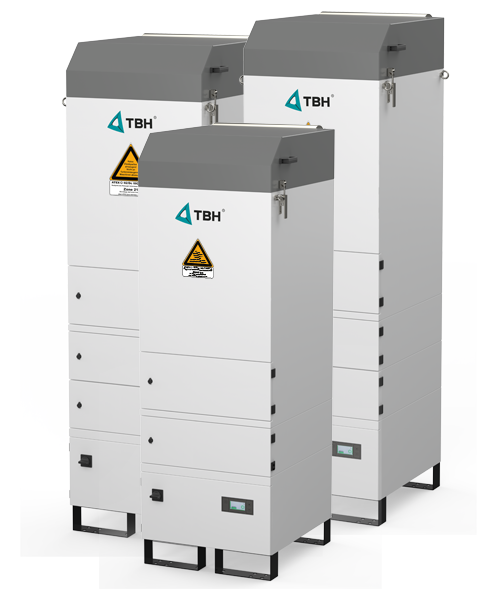
TBH FP 200 ATEX: developed for Zone 21 and higher dust quantities
If your process generates large quantities of dry, combustible dust, a robust extraction system tailored to the application is crucial. The TBH FP 200 ATEX systems are designed for this purpose and support stable operation – even in demanding dust situations.
Key features:
- Complies with the requirements of the ATEX Directive (RL 2014/34/EU)
- Suitable for extraction from Zone 21 – the system must be installed outside the zone
- Suitable for non-metallic dusts with a minimum ignition energy greater than 3 mJ
- Important: Whether the system is suitable for your specific application depends on the substance to be extracted and must be assessed individually by you as the operator.
Documentation that really helps you: Sample explosion protection document
Explosion protection does not end with the system – the interaction between the extraction system and the customer’s environment is crucial. That is why you receive a special sample explosion protection document that enables you to assess the entire system in a structured manner and to document the necessary steps in a comprehensible way.
In summary
If you work with non-metallic, combustible dusts and Zone 21 issues are relevant, a clear three-step approach has proven effective:
- Assess zones & risks (substance + process)
- Design suitable ATEX extraction (e.g., FP 200 ATEX)
- Document the entire system clearly (using the sample explosion protection document as a basis)
Would you like to check whether the FP 200 ATEX systems are suitable for your dust and process?
Send us the most important key data (material, process, zone, volume flow) – we will help you classify your application.
TBH GmbH | www.tbh.eu
Short video on the topic: https://youtube.com/shorts/SQVtiGc_Eb4?feature=share
