
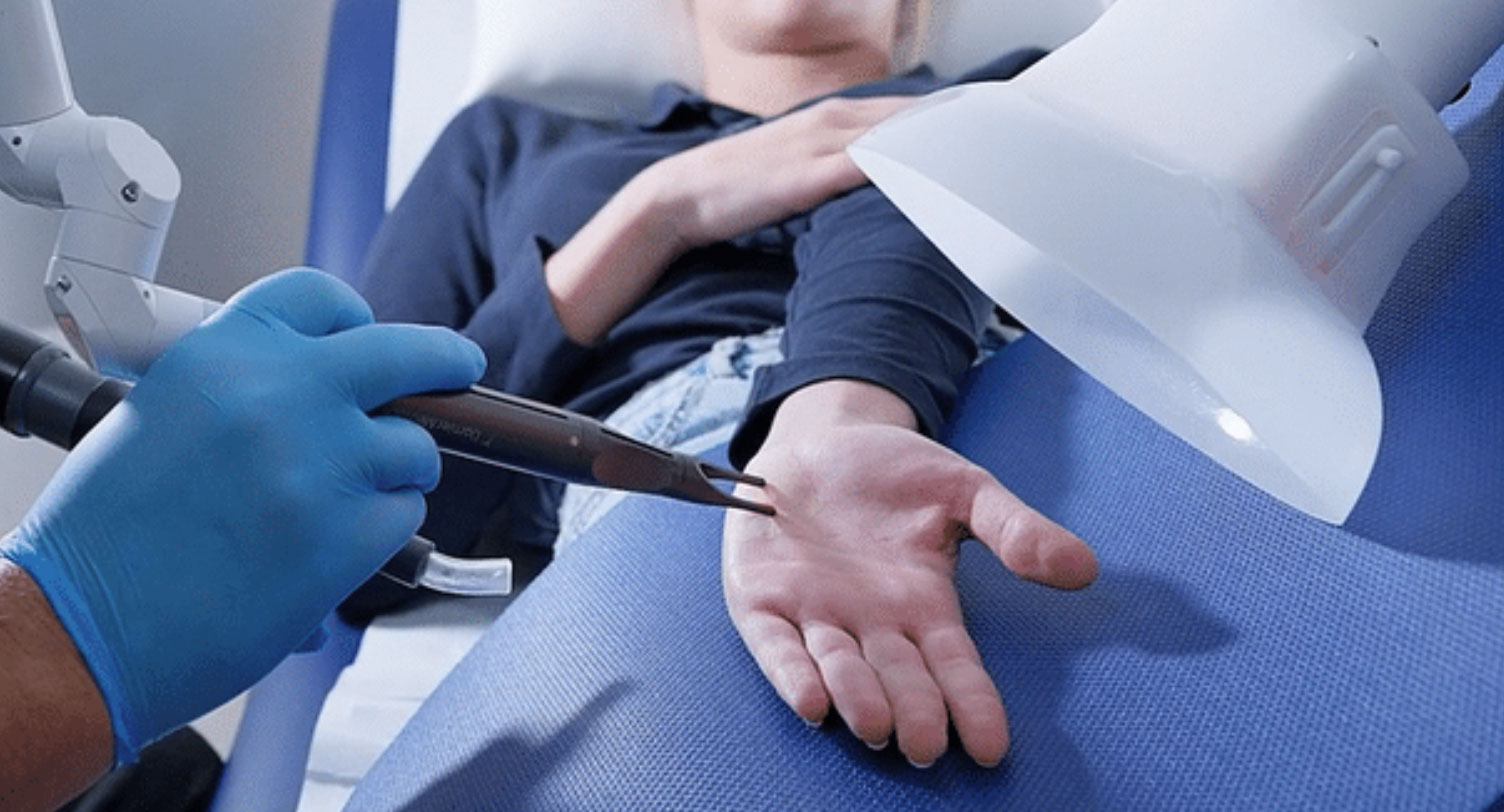
Formation of laser smoke in the treatment room
In ablative CO₂ laser therapies, tissue is vaporized by thermal action. This produces surgical smoke gases (“laser plume”), which can consist of a mixture of fine and ultrafine, respirable particles and biological components as well as gaseous substances.
Scientific studies show that a significant proportion of the particles contained in laser smoke are respirable (e.g., JCAD overview of laser-generated airborne contaminants 2024). In individual studies, viral DNA—such as HPV in HPV-associated lesions—has also been detected in laser plume or surgical smoke (including Palma et al., studies from Germany and other European centers on LEEP procedures, and a recent review in GMS Hygiene and Infection Control 2024).
This results in potential, recurring exposure for doctors and medical professionals in their daily practice.
Occupational safety and health framework in Germany
The following apply in particular to medical facilities:
- TRBA 250 – Biological agents in healthcare and social welfare
- Hazardous Substances Ordinance (GefStoffV)
- DGUV Rule 109-002 – Activities involving exposure to surgical smoke
These regulations focus on technical protective measures to minimize potential exposure. The central principle is to capture emissions as close as possible to the source. The practice operator remains responsible for carrying out a risk assessment.
Why technical extraction measures are useful for compliance with occupational safety in everyday dermatological practice
Surgical smoke consists mainly of fine and ultrafine particles that can spread throughout the room. Depending on their design, positioning, and maintenance, local extraction systems can help to reduce the particle concentration in the immediate working environment.
The following factors are crucial:
- Capture directly at the point of application
- Suitable filter technology
- Regular maintenance
- Professional integration into the treatment process
The TBH Health series – developed for medical applications
The TBH Health series was developed specifically for use in dermatological and aesthetic treatment rooms.
It enables:
- Targeted capture of laser smoke at the point of origin
- Integration into existing practice structures
- Support in the implementation of technical occupational safety measures
As a German manufacturer with over 30 years of experience in filter and extraction technology, we develop solutions that are tailored to the requirements of medical facilities.
Why is occupational safety important in everyday dermatological practice?
Ablative CO₂ laser therapies are an established procedure in dermatology. The surgical smoke produced is classified as relevant to occupational safety in German regulations. Technical extraction measures can help minimize potential exposure, depending on the individual application. The TBH Health series offers an application-specific solution for this purpose.
➡️ We would be happy to advise you individually on integrating a suitable extraction solution into your practice concept.
Sources: Laser-generated Airborne Contaminants | JCAD – The Journal of Clinical and Aesthetic Dermatology , Particulate Matter in Laser Plume | Plastic Surgery Key, Stefano Palma, Environmental Research, https://doi.org/10.1016/j.envres.2020.110437 , GMS | GMS Hygiene and Infection Control | Surgical smoke: a matter of hygiene, toxicology, and occupational health
