
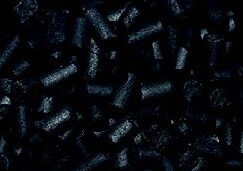
Adsorption with activated carbon: How activated carbon purifies the air
Adsorption with activated carbon is a proven method for removing gaseous substances from the air—for example, VOCs, vapors, odors, or smoke components. In many processes, particle filtration alone is not sufficient. This is precisely where activated carbon complements the filter system – for clean process air and greater protection in the working environment.
At TBH, the focus is always on the goal: triple protection for human beings, the environment, and machines.
What does adsorption with activated carbon mean?
In adsorption (with a “d”), molecules accumulate on a surface.
This is the key difference to absorption (with a “b”), in which substances “penetrate” a material.
In short:
Adsorption with activated carbon = molecules adhere to the surface of the activated carbon.
Why can activated carbon bind so many substances?
Activated carbon is extremely porous. These pores create a very large internal surface area. And the larger the surface area, the more molecules can be adsorbed.
In practice, this means:
- Many pores → large surface area
- Large surface area → extensive contact with air
- More contact → better binding of gaseous substances
This makes activated carbon particularly suitable for dealing with odors, vapors, and VOCs.
Physical adsorption: No chemistry, pure physics
In many applications, activated carbon works via physical adsorption. In this process, molecules adhere to the activated carbon surface through weak attractive forces (Van der Waals forces).
Important for classification:
- There is no chemical reaction.
- The bond is physical.
- The effect depends on the type of substance, concentration, temperature, humidity, and contact time.
Where is adsorption with activated carbon used?
Adsorption with activated carbon is used wherever gaseous emissions are relevant—for example:
- Gases & vapors from cleaning and dissolving processes
- VOCs during gluing, coating, or in plastic-related processes
- Odors that are disruptive in the work area or cause complaints
- Smoke components when the gas phase plays a role
Typical industries:
- Paint shop / coating
- Laboratory / chemical-related processes
- Metal processing (e.g., cleaning vapors)
- Food industry (depending on the process)
This is what a sensible filter chain looks like
In extraction technology, activated carbon is often an additional filter stage – usually after particle filtration. This makes sense because dust can contaminate the activated carbon.
Typical structure:
- Prefilter (protection of subsequent stages)
- Particle filter (e.g., fine dust/HEPA – depending on the process)
- Activated carbon filter (gas phase: VOCs, vapors, odors)
This keeps the activated carbon effective for longer and improves its service life.
Advantages of adsorption with activated carbon
When activated carbon is designed to suit the application, you often benefit from:
- ✅ Broad spectrum of pollutants (especially organic vapors/VOCs)
- ✅ Noticeably better air quality in the working environment
- ✅ Greater occupational safety when the gas phase is relevant
- ✅ More stable processes, e.g. in applications where odors or measured values are critical
What influences the performance of an activated carbon filter?
The following points are crucial for adsorption to work reliably:
- Type of substance (not every substance adsorbs equally well)
- Concentration (high load = faster saturation)
- Volume flow (amount of air per time)
- Contact time (how long the air flows through the medium)
- Temperature & humidity (can influence adsorption)
- Pre-filtration (dust reduces service life)
Practical tip: If you want to evaluate the activated carbon stage, the substance/process, type of emission, volume flow, and your target (odor, VOC, measured value) are often sufficient.
When should you change the activated carbon filter?
An activated carbon filter does not “fill up” visibly like a dust filter. Therefore, a clear maintenance approach is important. Typical signs are:
- Odor despite the system being in operation
- Rising measured values (internal/external)
- Maintenance interval reached (TBH recommends at least once a year – shorter depending on the application)
Important: Many systems do not monitor activated carbon separately on the display. That is why activated carbon replacement should be included in your maintenance plan – including documentation.
Quick check: Is adsorption with activated carbon suitable for your application?
Adsorption with activated carbon is particularly useful if at least one of the following points applies:
- Are VOCs or solvent vapors produced?
- Is there odor pollution that causes annoyance or complaints?
- Do measurement values have to be kept stable?
- Is the gas phase relevant (not just particles)?
Video: Adsorption with activated carbon in 60 seconds: https://youtube.com/shorts/RzAtbKMLcmI
Here you will find a short video on the topic (ideal for embedding in your article):
(Insert YouTube link / embed)
More about TBH extraction and filter systems: www.tbh.eu
Conclusion
Adsorption with activated carbon uses a huge surface area to physically bind gaseous substances. This makes activated carbon filters the ideal solution for VOCs, vapors, odors, and smoke components – wherever clean air is not just a matter of comfort, but a real factor in process and occupational safety.
Would you like to have your application checked?
Send us a brief description of the substance/process, type of emission, volume flow, and target (odor/VOC/measured values). The TBH team will then assist you in selecting the appropriate filter stage and maintenance logic.
