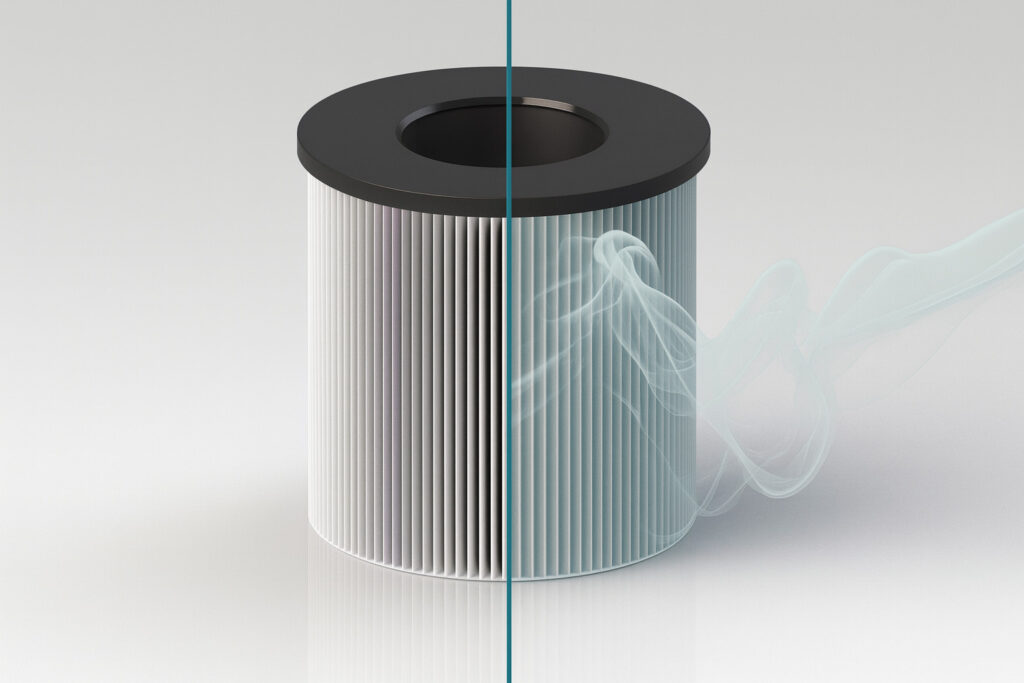
When filtering sticky, moist, or very fine dusts, conventional filter cartridges quickly reach their limits. Precoating protects the filter surface with an additional layer, facilitates cleaning, and significantly extends the filter’s service life.
What is precoating?
In precoating, an additional protective layer is applied to the filter cartridge before the actual filtration process. This layer consists of a suitable precoating agent (e.g., a finely metered powder) that distributes evenly across the filter surface.
Dust particles first settle on this precoating layer and do not penetrate directly into the pores of the filter material. This keeps the filter protected. The accumulated particles can be removed from the filter surface with bursts of compressed air, ensuring that the filter itself remains clear and functional for longer.
In short:
Precoating = a protective layer for the filter cartridge that reduces wear and simplifies cleaning.
Why do filter cartridges clog so quickly—especially with sticky dusts?
Many applications generate critical dust emissions, for example:
- sticky dusts from resins, adhesives, or coatings
- moist dusts, such as in processes involving coolants or lubricants
- very fine dusts that penetrate deep into the filter pores
Without precoating, the following happens:
- The particles become lodged directly in the filter material.
- Sticky or moist components clog the pores.
- The filter cartridge becomes saturated quickly, and the differential pressure rises.
- Extraction performance decreases, posing a risk of process disruptions and downtime.
Result: frequent filter changes, increased maintenance effort, and rising operating costs.
How does precoating work in practice?
The precoat process typically involves several steps:
- Application of the precoat layer
- Before the process starts, the precoat agent is metered into the intake air. This forms an uniform protective layer on the filter cartridge.
- Filtration through the precoat layer
- During filtration, the particles collide with this layer and deposit there instead of penetrating directly into the filter material.
- Cleaning via compressed air pulses
- After a defined filtration cycle, a cleaning process begins, for example using compressed air pulses.
- The precoat layer detaches along with the adhering particles.
- The fine dust falls into the system’s dust container.
- Application of a new layer
- Subsequently, a precoat agent is added again, so that a new protective layer forms on the filter cartridge.
This cycle is repeated at regular intervals. This ensures that the filter cartridge remains functional significantly longer, even with high dust volumes or when dealing with wet or sticky dust.
What are the benefits of precoating?
Operators of filter and extraction systems benefit from several advantages:
- significantly longer filter service life
Since the actual filter cartridge is protected from direct contact with critical dusts, the filter material ages more slowly.
→ Fewer filter changes, less downtime.
- More stable extraction performance
Due to the regular cleaning of the pre-coating layer, the pressure drop across the filter stage remains constant for longer.
→ The system can be operated at constant performance for a longer period of time.
- Better cleaning for sticky dusts
Many sticky dusts adhere very strongly to filter media and are difficult to remove. With precoating, it is not the filter itself that is cleaned, but the precoat layer.
→ Cleaning is more efficient and gentler on the filter cartridge.
- Resource Conservation & Sustainability
Fewer filter changes mean:
- lower material consumption
- less disposal effort
- less downtime, more efficient use of the system
This aligns with the triple protection of human beings, the environment, and machinery that TBH stands for.
When is the use of pre-coating particularly beneficial?
Pre-coating is especially worthwhile in applications where:
- sticky or resinous dusts are generated (e.g., resins, adhesives, coatings)
- moist or clinging dusts occur (e.g., during mixing or transfer processes)
- very high dust loads with fine particles are present
- a long, stable filter service life is required, e.g., in automated production lines
In combination with cleanable filter cartridges, even difficult-to-handle dusts, such as sticky or moist particles, can be reliably captured.
Precoating in conjunction with TBH filter and extraction systems
TBH relies on modular filter and extraction systems that can be combined with suitable filter modules and, if necessary, with precoating, depending on the process.
The benefits for you:
- Adaptability to different processes and dust types
- Reliable separation even with critical dusts
- Predictable maintenance intervals instead of unplanned downtime
Especially in industrial applications where high-quality machinery, sensitive products, and employee health must be protected, the combination of proper filter technology and precoating is a key component for stable and safe processes.
Conclusion: Small layer, big impact
Pre-coating is a seemingly small measure with a big impact:
- It protects the filter cartridge from clogging.
- It facilitates cleaning.
- It ensures longer service life and stable extraction performance—especially with difficult dusts.
In this way, precoating makes a decisive contribution to making workplaces safer, protecting machinery, and reducing emissions—in line with the TBH slogan: Triple protection for human beings, the environment, and machinery.
TBH Video: Filter cartridge saturating quickly? The TBH solution: Precoating – YouTube
Contact the TBH expert team now: Contact – TBH GmbH Filter and Extraction Systems
Are you unsure whether precoating makes sense for your process—perhaps due to sticky, moist, or very fine dusts?
Then speak with our TBH team of experts. Together, we will analyze your application and find the right combination of filter cartridge, precoating, and extraction system for your production.